
Desmond’s Story
Desmond Hayduke Rinaldi
Born into the family of Chloe Wieland, Jacob Rinaldi & big sister Maya
Great Expectations
I knew going into the birth of my second child that I needed more support—before, during, and after the birth. I also knew that, despite my preference for how I wanted to give birth, birth was only one piece of the amazing experience of having a child, a helpful perspective. Most importantly, I knew that I wanted this birth to be different than the first, in which decisions were made based in fear, pressure, and lack of information.
We reached out to Michelle early in the pregnancy, seeking a midwife who would support a VBAC home birth. Although Michelle does support VBAC home birth, my partner and I eventually decided that I would give birth in the hospital, and Michelle would be with us every step of the way.
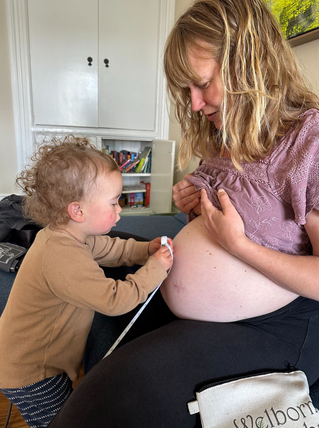
Michelle provided extraordinary prenatal care, letting my then 18-month old daughter help measure my growing belly and take my blood pressure. Michelle gave me a safe space to air my concerns, to talk through all the different choices ahead, to practice asking again and again for what I needed—from my partner, my medical team, my family, and my community.
Breech I
Around 36 weeks, I had an appointment at UCSF, where we had decided I would give birth. The nurse gently informed me that the baby had turned to a transverse position. My options were 1) go home and help him move back into an anterior position, 2) schedule an External Cephalic Version (ECV), where a doctor would manually turn him, a painful procedure with no guarantee of success, or 3) schedule a surgical birth. I wanted to avoid as much intervention as possible, most especially a surgical birth.
I was on the phone with Michelle discussing options (and holding back tears) before I left the waiting room. The next day, Michelle arrived at my house with Ilke, my amazing back-up midwife who, among her many talents, specialized in convincing breech babies to turn. Ilke and Michelle worked with me that afternoon to move Baby Dez, encouraging him to find his right place. I followed their instructions that evening, and soon felt big movements in my abdomen. I drove to Michelle’s house the next morning for verification. Yes, he had turned!
The staff at UCSF had scheduled an ECV around 38 weeks (with a doctor Michelle had recommended), which I needed to attend despite knowing he was no longer breach. They checked his position—head down, but while the ultrasound wand was on my stomach he moved again into a transverse position. Then he moved back. The doctors asked that I stay for an extended period to monitor his movements and heartbeat. After an hour or so, I was released and we headed home, but I had been flagged. Late that afternoon, I received a call from an L & D nurse, who strongly suggested I return for another monitoring session before the weekend.
Induction???
Friday, 4pm. I left Maya, now almost 2, with my partner Jacob, and headed to UCSF— feet dragging the whole way. It was not how I wanted to spend the afternoon. Maya had arrived after 41 weeks and I expected the same for Dez. I tried to relax, tried to enjoy reading a magazine, but my heart was full of anxiety as I reclined with a heartbeat monitor around my abdomen. Frequent monitoring and induction were high on my list of interventions to avoid.
Two clinicians attempted to explain that Dez’s heartbeat isn’t alarming, but isn’t reassuring either. I tried to be open-minded, interpreting their concern as: It’s not a problem, yet, but it could be. Michelle stayed on the phone with me throughout the session, supporting me with my decision to go home when the clinic closed, instead of heading to L & D to continue monitoring. I promised to return in the morning.
After dinner, I put my daughter to bed as usual and tried to go to sleep early, sensing that it might be my last restful night for a while. The next morning I tossed a few items in a bag: onesie, eyemask, phone charger. I said goodbye to Jacob and Maya, hopeful that I’ll be home for lunch but aware that our plans were on the verge of major disruption.
Again, monitoring led to concern. When the doctor announced that there is enough irregularity that he recommends an induction, I freeze. Consulting by phone, Michelle probed deeper, finally concurring that if I wanted a vaginal birth, which I absolutely did, I need time on my side. We needed to get started.
Waiting
The next few hours were a blur of logistics and planning, as I ran through the list of friends and neighbors who had agreed to help. As soon as Maya was safely handed over to friends, Jacob joined me at the hospital. By that point, they had already inserted a foley balloon and started an IV of pitocin. The team, a crew of fantastic nurses, midwives, doctors and residents, was incredibly encouraging, especially our day nurse. Michelle held my hand and I continued to work out care details for Maya. Once Jacob confirmed the flight for my stepmother, our primary postpartum support person, I relaxed and turned my attention inward.
Now that I had adapted to the new situation, I expected things to happen quickly, but ten hours later my cervix was still closed. We tested the foley balloon—nothing. I requested a lower pitocin dose so I could rest overnight. We started again on Sunday morning; surges came and went. I was in discomfort, but could breathe and walk and talk with relative ease.
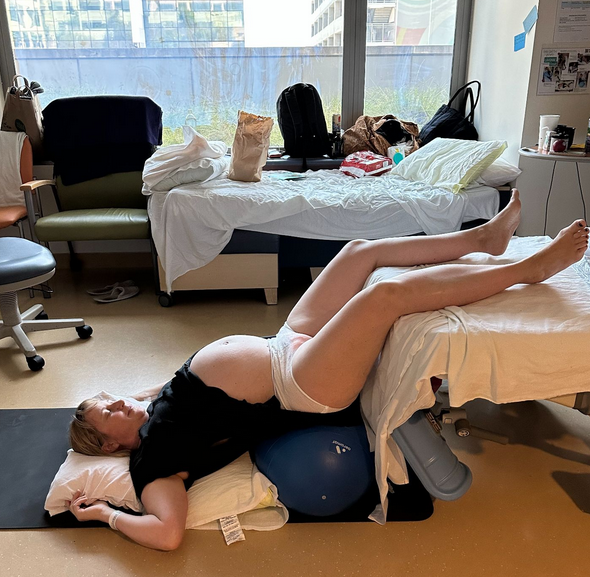
Then, another flip from Dez. The team removed the foley and stopped the pitocin. You can’t induce a breech baby. I clambered into my breech pose, head and shoulders on a birth ball, bed holding my pelvis higher than my abdomen. Ilke coaxed and Michelle whispered. It worked, Dez turned, head again toward my pelvis. A resident placed a different, slightly larger foley balloon into my cervix. Ilke spent the night in our room while Michelle attended another birth down the hall (!). The night team wanted to break my water and speed up the process, but Ilke’s presence gave me the confidence to wait.
Late Monday morning a nurse finally turned the pitocin back on. The surges intensified. Jacob helped me walk the halls, holding me when I needed to stop and breathe, bringing me back to the room when they got strong enough that I needed my props: the yoga ball, blocks, etc. Michelle hosted karaoke hour and every few minutes I moved into position to bear the surge. I felt strong and confident, eager to enter labor and meet my baby. Around 7pm, the end of the shift, I asked our favorite nurse to try the foley. Everyone cheered as it slid out.
The Baths
After the ballon came out, the surges lessened and eventually stopped. Jacob went to our house to help Maya with bedtime. He returned around 9pm to a quiet room. My energy had dropped, and I was heartsick for my daughter. He told me to get some rest, and laid down on the partner bed by the window. I wasn’t ready to stop, so I asked the nurse to continue the pitocin but also closed my eyes to a restless sleep.
Around 3 or 4am I felt another big movement and immediately knew he had flipped again. Unbelievable. The nurse checked his position and confirmed my suspicion. By this point I’d lost count of how many times he had turned. Each flip slowed us down, and meant that he was still high. We were running out of options and I was disappointed. However, the lack of “progress” gave us the opportunity for Maya to visit. I was so happy to see her.
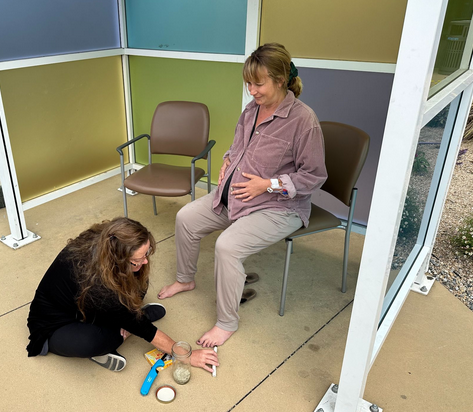
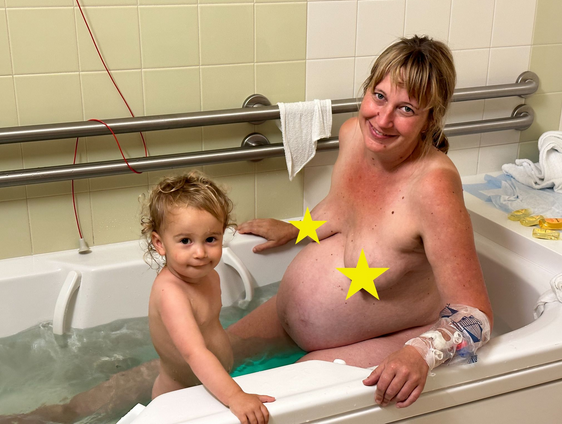
Michelle arrived shortly after Maya, and we all went out to the rooftop garden. I cuddled my daughter while Michelle applied moxibustion sticks to encourage Dez to turn (again). When we returned to the hospital room, I ran a bath. Maya and I splashed around in the giant tub and told baby Dez we were ready to see him and wanted him to come soon. Maya nursed, ready to do her part to help bring on labor. By late morning Dez was back in the head-down position.
Maya’s visit energized and rejuvenated me. While Jacob drove Maya back to the house, I conferred with the birthing team and we decided it was time to break my water. Here was one more intervention I thought I didn’t want, but I held tight to my desire for a vaginal birth, which meant adjusting my expectations along the way. I felt grateful not to feel rushed, and to make the decision with a team of people I had confidence in.
Ilke and Michelle sat on each side of me, holding my hands as the nurse midwife inserted a needle into my cervix. Then she frowned and announced that the bag had slipped away. Dez had flipped again, moving into breech mid-procedure. I quickly moved my own body upside down, lowering my head and chest off the bed to help my pelvis hold the water while we discussed what to do next. The midwife wasn’t certain that she had punctured the bag but within a few minutes I felt a drip and a puddle behind my back confirmed that the bag was open.
The doctor recommended an immediate ECV. Wanting to have as much fluid in the bag as possible, they determined that it can be done right where I am. We couldn’t wait for Jacob to return, but Michelle called to give him an update. Surrounded by this wonderful team, I relaxed and let the doctor press on my abdomen, gently turning Dez again into a head-down position. Within minutes, the rest of the water has released.
To hold Dez in position, Michelle wrapped several long scarves tightly around my torso. We built a throne of cushions and blocks on the bed, where I sat feeling my motherly power, ready to offer everything I have to this bringing my child down to earth. I welcomed the pitocin. We played music, sang, danced, told stories about our lives, our families. Despite my strongest desires, everything slowed. The dilation I had gained from the foley balloon shrank. Fatigue began to set in.
Still trying
When evening came, I was ready to lay down. I had been upright for 9 or 10 hours. I laid on my side, carefully, still wrapped up, but within seconds the nurse came in. Dez’s heart rate had dropped. While she moved me to the other side, other people come and watch the monitors. I followed their suggestions, moving into different positions. Finally, on hands and knees his heart rate stabilized, but I can’t stay like this forever.
The day team has left and in the first meeting with the night team they recommend an epidural. At first it’s hard to understand the suggestion—if laying down is difficult for Dez, why take away my ability to move? Because it’ll be easier to get to the operating table in case of an emergency.
With that new understanding, I decided it was time to check in with my baby. Michelle helped me undress, disconnected my wrist from the IV pole, and offered her arm as I climbed into the tub. Then she and Jacob went for a walk, while I sat in the purple-hued water, taking a short journey with my child.
A New Plan
After twenty to thirty minutes in the bath, I called out to Michelle and Jacob. I’d almost forgotten that I was in a hospital, not a fancy hotel. It’s eleven pm on Tuesday night, 87 hours since I arrived at UCSF. I passed on the message from Dez: he’ll give it one more try to arrive vaginally, but if there is any further indicate of struggle, we’ll head to the OR.
A minute later, the screen beeped, long and sharp. His heartbeat had dropped again and was taking a long time to bounce back. We could all see he needed help. I breathed in deeply and asked the nurse to prepare me for a cesarean.
One of the most significant ways Michelle made this birthing experience better, despite being back in the hospital, is that she fully validated the fears and concerns I brought from my previous birth experience. Not only has she held them for me the whole pregnancy, she has also encouraged me to share these fears with the birthing teams, (many by this point!), so that everyone in the room would be aware of my specific needs, and could collaborate with me and Jacob to do things better.
Thus, when we proceeded to the operating room, the first thing the anesthesiologist does is place a warmed blanket on my chest. The give Jacob a seat beside my head. The team refused our request to have Michelle in the OR, but she is scrubbed up and ready to come in if Jacob needs to leave: I won’t be alone. Indeed, I was so comfortable, and exhausted, laying on the operating table, that I actually dozed off, my snoring interrupted only when my son is pulled from my belly. He’s perfect, and healthy, and has a very tight knot in our umbilical cord.
Jacob held Desmond near my face, so I could see him and stroke his face. My position was too awkward to hold him comfortably, but I knew I’d be holding him soon. The mood in the room is cheerful, celebratory. We were so happy to see him, arriving at just the right time and in the way he needed to.
I’m so grateful for the love and care I received throughout the birth experience, especially the time I needed to connect with my baby, to make decisions based on trust, instead of fear, which led to this beautiful, slightly dramatic, birth—the real plan all along.
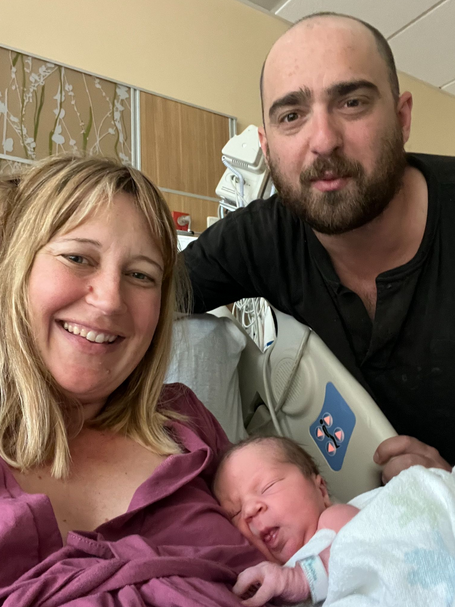
Desmond Hayduke Rinaldi was born weighing 7 pounds, 0 ounces at 1:58am on September 13, 2023.
Quisque iaculis facilisis lacinia. Mauris euismod pellentesque tellus sit amet mollis.